Week 8: Pseudocode
This week, we continued our class about pseudocode.
Week 9: Flowchart
This week, we learnt another presenting way that is similar to pseudocode, but in a different visual form. It is called a flowchart. Its definition is “Diagram that illustrate the sequence of operations to be performened to get to the solution of a problem.” It is a form to represent pseudocode. After writhing a page of pseudocode, people can change it into a flowchart, which is easier to read.
In a flowchart, different shapes means different processes. For example, a circle refers to the beginning or end of the process; a rectangle means the middle process; a diamond refers to a choice, and must be answered with “yes” or “no”; a parallelogram means a input or output process. These process-representing patterns should be connected with arrows.
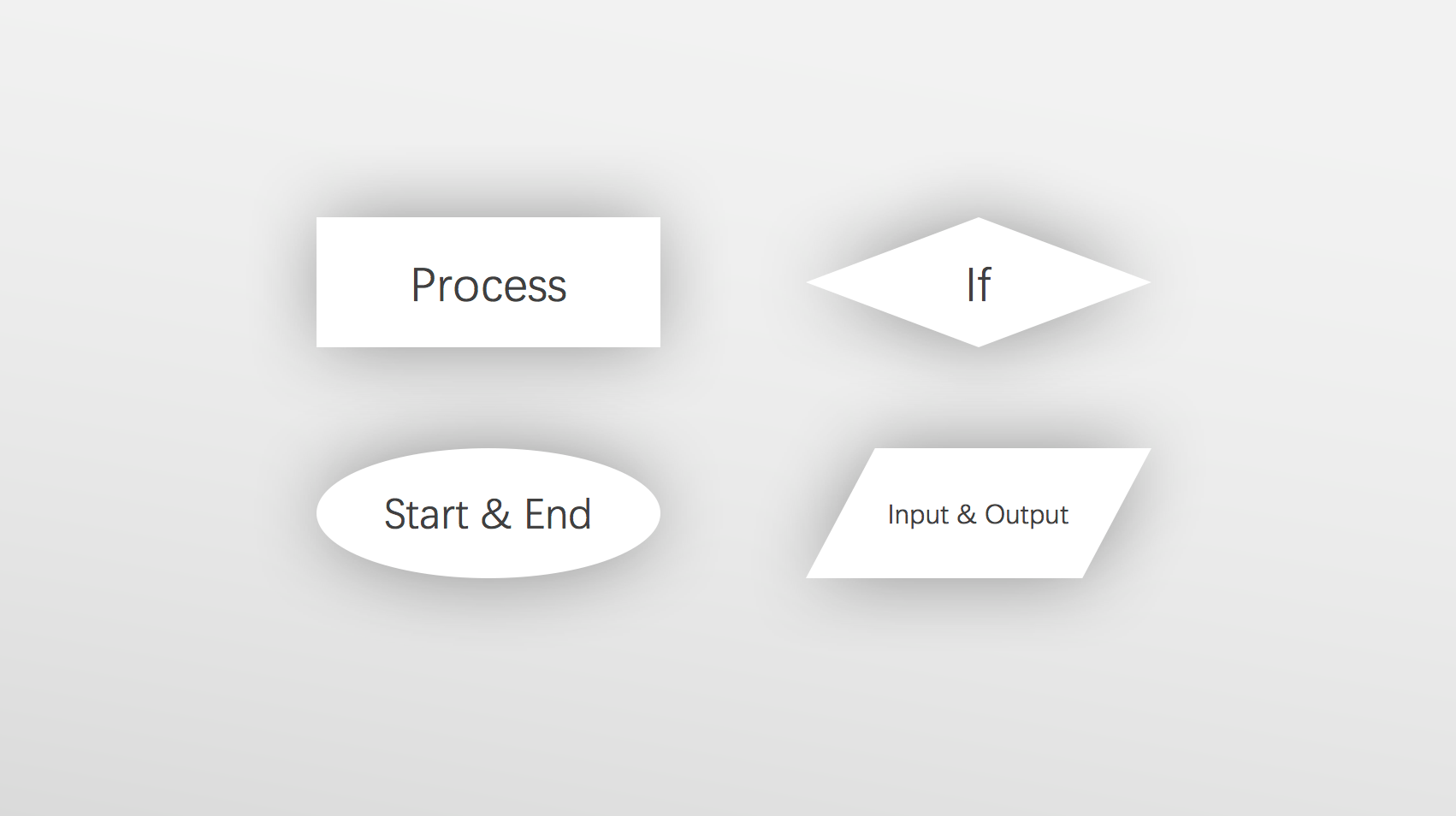
When making a choice of decision, “if” is a frequently-used word. There are several patterns related to the if condition. IF-ELSE is other conditions that are not contained in the previous if condition; IF-ELSE-IF is another condition after an existing choice of NO, while Nested-IF is another condition after a YES. A loop, on the other hand, is used when the condition could not be reached continuously, until it is finally be reached.
In the class, we learnt two forms of precess in pseudocode or flowchart: abstract steps and concrete steps, by redoing the “boiling egg game”. Processes like “Get an egg” is relatively abstract, while steps like “go for the fridge, open the door, reach out you hand…” is obviously more precise, and there are known as concrete steps. I remember last time during a game, which I led Tenny to a certain position in the classroom by commands, “turn right a little bit” was an abstract step, while “go right for 20 centimeters” was a concrete step.
Finally, we were asked to make a poster concerning a certain process, which must be represented by flowchart and pseudocode. Charlotte and I were in a group, and we decided to come up with a process about choosing an earphone, as Charlotte was an expert in this area.
 JIHONG ZHAO