This week, we learnt mainly learnt about digits and numbers in computing system.
Numbers
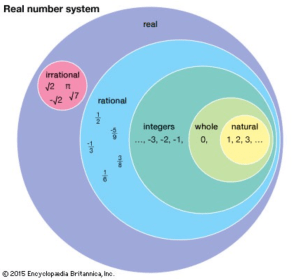
There are several sets of number in the number system: natural number (1, 2, 3…), whole number (0, 1, 2, 3…), integers (numbers that can be represented by fractions), rational numbers (integers and infinite repeating decimals), irrational number (infinite non-repeating decimals) and real numbers (all numbers on the number axis).
Binary, Decimal and Hexadecimal
Binary is a base 2 counting system. From 0, when we count to 1, we add another digit on its left. Decimal is a base 10 counting system. From 0, when we count to 9, we add another digit on its left. Hexadecimal is a base 16 counting system. From 0, when we count to F, which is 15, we add another digit on its left. Bit is the basic unit of number in computing system. It can hold binary digits. 8 bits compose a bite, which can hold 256 different objects.
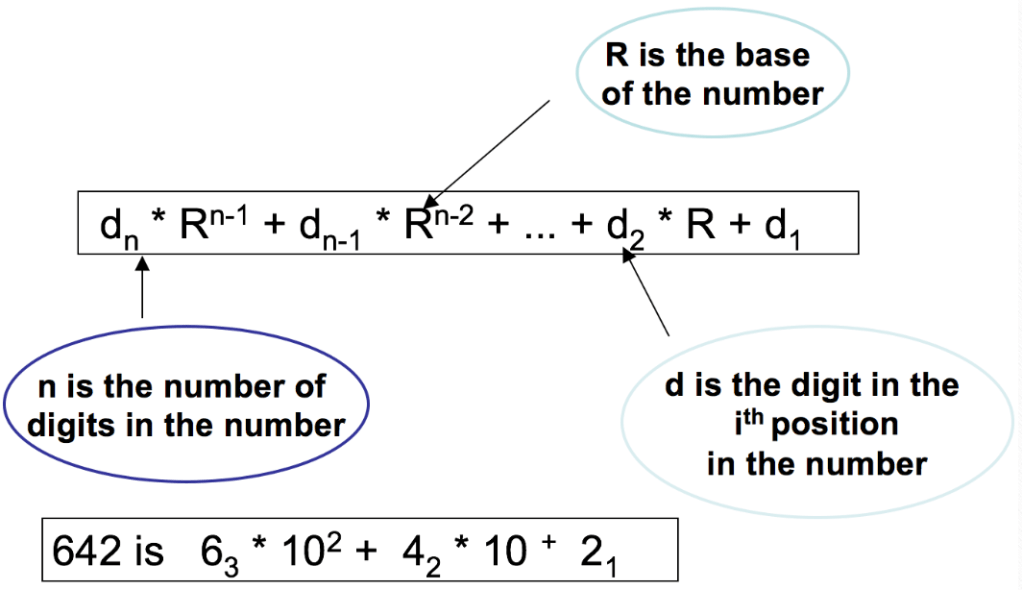
When converting a base N number to decimal, we can use the following equation, which is known as notational position to achieve this.
When converting a decimal number to other base number, we can follow the following process:
While (the quotient is not zero)
Divide the decimal number by the new base
Make the remainder the next digit to the left in the answer
Replace the original decimal number with the quotient
And the combination of those remainders, from the last one to the first one, would be the final result.
There are some short cut when converting binary to octal and hexadecimal: divide them into several groups with 3 (for octal) or 4 (for hexadecimal) digits in a group, and convert each group in to a digit of octal or hexadecimal.
Arithmetic in Binary
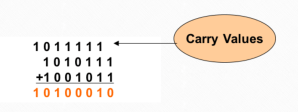
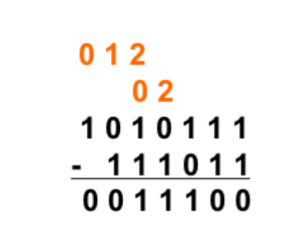
A carry (1 at then next t digit) would be used when adding in binary. There are only two digits in binary: 1 and 0, so when a 1 is added to a 1, a carry is used to represent a 1 in the next digit. When subtracting binary numbers, we need to borrow a 2 from the next digit if a 0 is subtracted by a one.
Analog VS. Digital
Next, we learnt about data representative in computer. First, data can be represented in two way: analog data and digital data. Analog data is a continuous representation. It is similar to the original situation, like a thermometer, but there are too much fluctuation. Digital data, a discrete representation, is used in computing system, and there is only “yes” or “no” in this form. Analog data can be digitize into digital information by breaking them into pieces. Because of the clear and standardized feature, digitization is important in computing and transforming information. However, both of them would degrade during transporting, so we need to “reclock” the information from time to time, which means to use a amplifier to strengthen the information that degrades.
Two’s Compliment and Binary Fraction
When we want to represent negative values in binary, we can use two’s compliment. The first digit on the left of a bite determines whether the number is positive or negative. For positive numbers and 0, the first digit is 0, and we represent it normally with the left 7 digits. For negative numbers, the first digit is 1, and we write the positive value of it first, and then convert all 0 to 1 and 1 to 0, and then add one to get the final result.
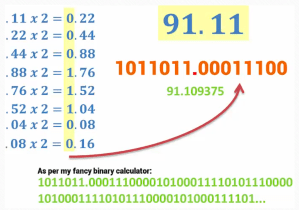
Binary fraction is using binary to represent some integers. The first digit on the right of the decimal mark represents 1/2, the second digit represent 1/4, and the third one represent 1/8… When we want to represent a fraction that cannot be comprised by those 1/2^n, we usually use the following steps to represent it:
Sensors and Microprocessers
For HL class, we looked at sensors and microprocessors. Before new stuff, we, again, reviewed the input, processing and output chain:

There are 8 types of sensors that we learnt:
- Sound sensor: detect sound waves (microphone)
- Motion sensor: detect movements (elevator)
- Vibration sensor: detect vibration (amplifier on guitar)
- Active pixel sensor: detect visible light (cameras)
- Infrared sensor: detect invisible energy (TV)
- Pressure sensor: detect pressure (iPhone)
- Proximity sensor: detect distance (automative door)
There are three properties of sensors:
- Accuracy: when the length is 10 cm, we don’t want to get a 10.1 cm.
- Range: a thermometer may stop working at the North Pole is the range is from 0ºC to 100ºC .
- Resolution: when the length is 10.1 cm but the ruler only have 10 cm and 11 cm, then we may say that this ruler has a low resolution.
There are also two basic characteristics of sensors:
- Sensors should not be influenced by confounding variables. E.g. when we want to measure the temperature, the thermometer should not be influenced by the speed of wind.
- Sensors should not influence the factors that it measure. E. g. when we want to measure the temperature of a cup of water, the thermometer should not change the current temperature of the water.
In class activity, we came up with some other possible characteristics that should be considered when designing or evaluating a sensor.
- It should do no harm to human.
- It should do no harm to environment.
- It should be as portable as possible.
- It should be durable.
- …
Next, we talked about microprocessors. We learnt three types of microprocessors:
- General purpose: can do a lot of things. (E.g. CPU)
- Embedded controller or micro controller: focus of specific tasks. It needs no whole computing system. Lower power is required.
- Graphics processing unit: focus on mathematical graphing. (It would be particularly used in 3D games and modeling art.)
Q&A Questions
- 0 1 2 3 4 5 6 7 8 9 ⑩ ⑪ ⑫ ⑬ ⑭ ⑮ ⑯ ⑰
- A: 354 B: ⑰⑮9 C: 1
Last but not Least…
Things we learnt this week were the basic rules deep inside the computing system. It may not be directly seen in everyday usage, but it is vital in helping us to develop computational thinking and logic.
 JIHONG ZHAO